LightLink: Powerline-to-Light Communication
A routine message is only useful if it reaches its recipient. LightLink investigates how power wiring, a controlled reserve and a local light receiver could reduce interruptions in non-critical updates.
Overview
Imagine a maintenance update arriving in bursts at a fixed receiving point: the listener waits or asks for a repeat. LightLink explores whether suitable existing electrical wiring and a local visible-light receiver could support that non-critical service. The engineering problem is uneven delivery before the light transmitter. The work combines PLC characterisation, measurement-based FIFO sizing, ESP32 integration and a visitor-facing message studio. For Selah, it demonstrates practical skills in connecting hardware to usable software and testing the limits of a data path. It is university research, not a deployed mine communication product.
The Challenge
Problem
A high average powerline rate can hide multi-second delivery interruptions. A local optical transmitter needs a reserve of data, but excessive admission fills the queue and rejects arrivals.
Environment
Two university laboratories, domestic-scale cable arrangements and appliance conditions. The integrated comparison used a connected 65 W laptop charger and a 3 cm aligned optical bench link.
Goal
Characterise packet delivery, size a finite reserve and compare startup and sender-pacing modes without confusing adapter ratings, optical clock settings and useful received payload.
System Architecture
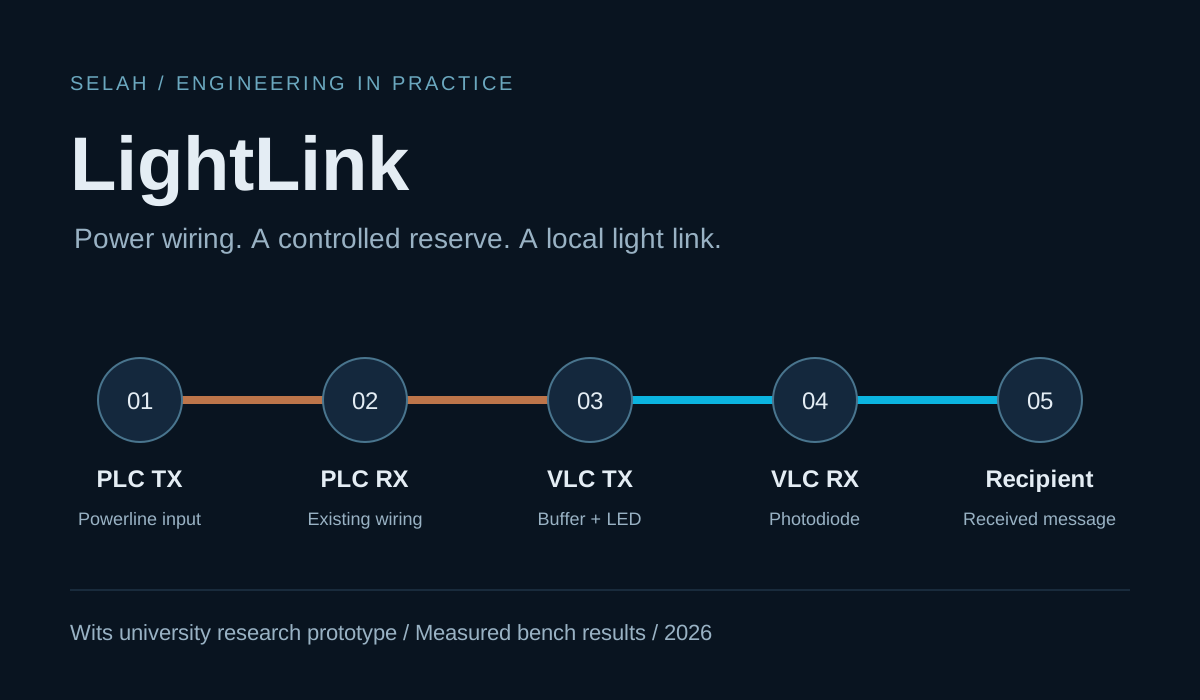
PLC TX and PLC RX
Commercial HomePlug adapters carry data over existing power wiring. A separate TL-PA7017 pair was used for characterisation; integrated tests used TL-PA4010 and TL-WPA4220 adapters.
Gateway / VLC TX
An ESP32-managed 105,472-byte FIFO waits for the declared 75% startup fill. Sender-side occupancy feedback targets 85% fill; nominal optical operation was 280 kbit/s.
VLC RX and recipient
An LED transmits to a photodiode receiver. Receiver observations reconstruct messages for display; the mobile demo confirms a source match and idle hardware before declaring delivery.
Mobile experience
Visitors draw, upload an image or write text in the browser. A queued bridge sends the prepared payload to the rig. Offline practice is explicitly simulated.
Technical Stack
- ›HomePlug PLC adapter pairs and domestic-scale cable arrangements
- ›ESP32 gateway, LED transmitter and photodiode receiver
- ›105,472-byte FIFO (103 KiB)
- ›Gated startup and occupancy-feedback sender admission
- ›Nominal 280 kbit/s optical setting during integrated tests
- ›Receiver records and buffer status kept distinct
- ›Python capture and analysis tools; packet-arrival evidence
- ›A mobile message studio with queueing and verified reception
- ›Separate sender and receiver bridges with the original RX dashboard
Results
| Metric | Immediate fixed-rate mode | Selected gated-feedback mode |
|---|---|---|
| Mean received payload after 5 s | 204.91 kbit/s | 201.24 kbit/s |
| Buffer behaviour | Queue saturated | 84.96% mean fill after 5 s |
| Recorded full-FIFO rejections | 19,719 across three complete captures | 0 across three complete captures |
Engineering relevance to Selah
- 1Facility monitoring needs a dependable path from an embedded device to the person using its data. LightLink demonstrates measurement, queue management and integration skills relevant to that work.
- 2Potential future use: non-critical maintenance or status messages at a fixed receiving point, subject to cable, optical, equipment and site-approval assessment.
- 3PLC characterisation: Nduvho E. Ramashia. VLC subsystem: Israel Chiloane. Buffer requirements, integration and analysis: shared. Supervisor: Prof. Ling Cheng. This is a university project, not a Selah client deployment.
Technical Insights & Lessons
Integrated comparison: five modes, three 60-second repeats per mode, 65 W charger present, iron off, 3 cm optical separation, 0-degree alignment, 280 kbit/s nominal. The results are bench observations, not service guarantees.
The PLC survey contains 31 arrival records over 5,393 seconds; its longest gap was approximately 5.46 seconds. The 2.5-second reserve is an empirical sizing target under ideal recovery, not independently validated outage coverage.
The 300 kbit/s sizing basis and tested optical maximum are distinct from the 280 kbit/s nominal setting and 201.24 kbit/s measured useful payload.
The selected feedback mode favours reserve and admission headroom over the slightly higher output of immediate fixed-rate buffering. Five zero-output counter windows remained among 327 post-startup windows.
No mine deployment, speech playback quality, mine-wide coverage, installation savings or timestamped end-to-end latency was demonstrated. Site-specific validation is needed before operational use.
Ready to Add Real-Time Monitoring to Your Facility?
Tell us about your facility, environment, and what you need to measure. We'll scope a system that works - sensors, firmware, dashboard, and deployment.